![Optii Logo 3x (2)-3.png]](https://help.optiisolutions.com/hs-fs/hubfs/Optii%20Logo%203x%20(2)-3.png?height=40&name=Optii%20Logo%203x%20(2)-3.png)
Understanding the Job Activity Report
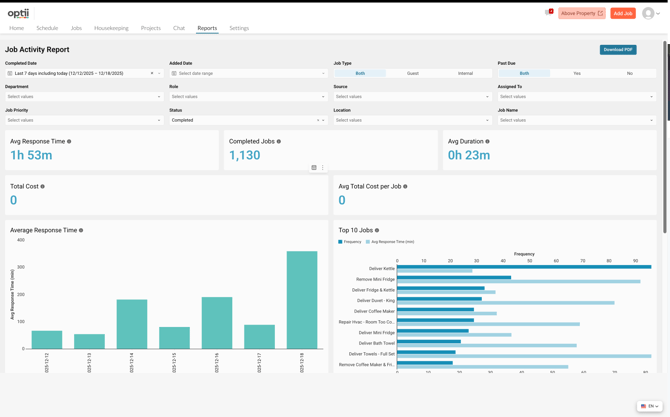
The Job Activity Report is your primary tool for auditing service performance and departmental efficiency. It transforms raw data into actionable insights, allowing you to see exactly how your team is responding to guest requests and internal tasks.
The Goal of This Report
The core objective of the Job Activity Report is to identify service bottlenecks and optimize labor allocation. By reviewing this report, managers can determine if the property is meeting its service-level agreements (SLAs) and identify which specific job types (e.g., "Deliver Kettle" or "Repair HVAC") are impacting guest satisfaction.
1. Navigating the Key Performance Indicators (KPIs)
At the top of your report, you will find four critical metrics that provide an instant snapshot of your operations:
-
Avg Response Time: The average time elapsed between a job being created and a team member completing the job.
-
Completed Jobs: The total volume of jobs finished within your selected date range. High volume with high response times usually indicates a need for more staffing.
-
Avg Duration: How long it takes to actually complete the work once started.
-
Total Cost / Avg Cost: Tracking the financial impact of your service delivery.

2. Visualizing Trends and Outliers
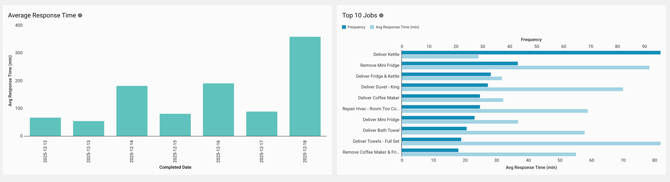
The report includes two powerful charts to help you spot patterns quickly:
Average Response Time (Daily Trend)
This bar chart tracks your speed of service over time.
-
💡Best Practice: Look for "spikes." If your response time jumped to over 300 minutes on a specific date, cross-reference that date with your occupancy or staffing levels to find the root cause.
Top 10 Jobs (Frequency vs. Speed)
This dual-axis chart compares how often a job occurs (Frequency) against how long it takes to respond (Avg Response Time).
-
🎯Target: Identify jobs with high frequency but slow response times. For example, if "Deliver Towels" is your most frequent job and has a 60-minute response time, improving that one workflow will have the biggest impact on your overall guest satisfaction score.
3. The Data Grid (Reporting Records)
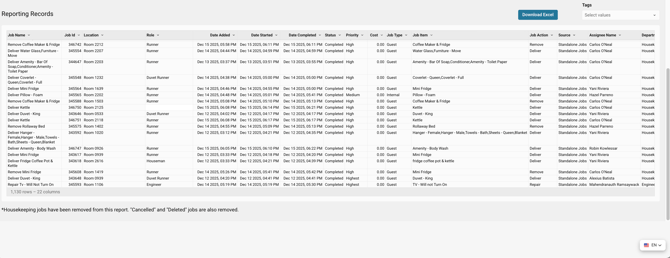
Beneath the charts is the Reporting Records table. This is where you can perform a deep-dive audit:
-
Wait & Response Columns: View the exact time a guest waited ($HH:MM:SS$) for every single request.
-
Assignee Name: See who completed the task to recognize top performers or identify team members who may need more training.
-
Source: Understand where jobs are coming from (e.g., "Standalone Jobs" vs. Integrated systems).
Best Practices
To get the most value out of this report, follow these three tips:
-
Filter by Priority: Use the "Job Priority" filter to ensure your "High" and "Urgent" tasks have significantly lower response times than "Low" priority items.
-
Monitor "Past Due" Status: Use the "Past Due" filter to see only the jobs that missed their target completion time. Use this as a "Learning Moment" for your morning briefings.
-
Audit Job Types: If "Internal" jobs are taking longer than "Guest" jobs, it may indicate that your team is prioritizing guest-facing tasks effectively, but your back-of-house maintenance is falling behind.
- Filter by Tags: Using tags allows you to categorize specific service scenarios that aren't captured by job names alone:
-
Guest Recovery: Filter by this tag to see the response times for guests who have previously had a negative experience.
-
Late Check-Outs: Track how many services were provided specifically for late departures to measure the impact on your cleaning schedule.
-
Special Requests: Monitor high-touch items like "VIP Setup" to ensure premium service standards are met.
- To learn more about Tags click here: https://help.optiisolutions.com/a-step-by-step-guide-to-using-custom-job-tags
-
- Export Data & Reporting: to facilitate deep-dive analysis or inclusion in monthly owner presentations, use the Export functionality:
-
Excel/CSV: Ideal for manual calculations, creating pivot tables, or merging data with other property financial systems.
-
PDF: Best for "ready-to-read" snapshots to share during morning briefings or departmental meetings.
-
Want to save time and have these insights delivered directly to your inbox?
We offer Automated Reporting based on your current subscription and invoice tier.
-
Custom Scheduling: Receive daily, weekly, or monthly summaries automatically.
-
Stakeholder Distribution: Ensure every department head sees the data they need without manual exports.
Interested in upgrading? Contact your Success Manager today for a personalized quote and a walkthrough of our automated reporting features.